Monday, January 18, 2010

Letter from Birmingham Jail


When thinking of Martin Luther King Jr., many a minds eye will jump to the powerful "I Have a Dream" speech delivered before the multitude on the steps of the Lincoln Memorial or perhaps to the moving "I've Been to the Mountaintop" sermon given in Memphis, Tennesse. It is in these indelible images and his stirring orations that King, the civil rights leader, is lauded and remember.


But Martin Luther King, Jr. was also a man, a husband, a father... who lived, day to day, in the word of Jim Crow segregation, of blatant discrimation, and of violent intolerance. It was this world that he protested in Birmingham, Alabama in April of 1963 as part of a planned non-violent protest conducted by the Alabama Christian Movement for Human Rights and King's Southern Christian Leadership Conference against racial segregation by Birmingham's city government and downtown retailers. King was arrested and jailed in the course of the protests which produced many of the iconic and heart wrenching images of the civil rights movement.


It is then while in jail, King wrote the "Letter from Birmingham Jail" on April 16, 1963. The civil rights movement was fracturing. Some with the movement agitated for ever more aggressive street protests while others pressed for the battle against racial segregation to be fought solely within the courts. Indeed, King's letter was a response to a statement released by eight white Alabama clergymen on April 12, 1963, titled "A Call For Unity". King was increasingly leaning towards the more radicalized segements of the movement believing that without nonviolent forceful direct actions such as his, true civil rights could never be achieved.

It is these calm yet resolute words of King the man that have touched me so deeply. Read... He explains why waiting (for the courts) is impossible.

"Perhaps it is easy for those who have never felt the stinging dark of segregation to say, "Wait." But when you have seen vicious mobs lynch your mothers and fathers at will and drown your sisters and brothers at whim; when you have seen hate-filled policemen curse, kick and even kill your black brothers and sisters; when you see the vast majority of your twenty million Negro brothers smothering in an airtight cage of poverty in the midst of an affluent society; when you suddenly find your tongue twisted and your speech stammering as you seek to explain to your six-year-old daughter why she can't go to the public amusement park that has just been advertised on television, and see tears welling up in her eyes when she is told that Funtown is closed to colored children, and see ominous clouds of inferiority beginning to form in her little mental sky, and see her beginning to distort her personality by developing an unconscious bitterness toward white people; when you have to concoct an answer for a five-year-old son who is asking: "Daddy, why do white people treat colored people so mean?"; when you take a cross-county drive and find it necessary to sleep night after night in the uncomfortable corners of your automobile because no motel will accept you; when you are humiliated day in and day out by nagging signs reading "white" and "colored"; when your first name becomes "nigger," your middle name becomes "boy" (however old you are) and your last name becomes "John," and your wife and mother are never given the respected title "Mrs."; when you are harried by day and haunted by night by the fact that you are a Negro, living constantly at tiptoe stance, never quite knowing what to expect next, and are plagued with inner fears and outer resentments; when you are forever fighting a degenerating sense of "nobodiness" then you will understand why we find it difficult to wait. There comes a time when the cup of endurance runs over, and men are no longer willing to be plunged into the abyss of despair. I hope, sirs, you can understand our legitimate and unavoidable impatience."

Tuesday, December 8, 2009

Hermann Architecture

Welcome Outdoor Wednesday...


Autumn & Architecture in Hermann, Missouri:


....................................................................
But my favorite "Architecture" was there long before.
....................................................................

Saturday, December 5, 2009

Vintage Cowboy


My daughter's horse riding coach is also co-worker of mine. Kirsten is having her first baby, a boy, due in January so I was so very happy to host her baby shower at work. Right away I knew we had to do something fun and unique for my fun and unique friend. Besides, Kirtsen is not exactly the pastel, ballons, and punch kind of gal. I found this fantastic fabric and decided on building the shower around it. Kirsten had a vintage cowboy baby shower.


I covered the table in red bandana fabric with the vintage print as a runner. The centerpiece was the little saddle Olivia uses while training. Around it I place vinatge toys like a pop-gun, and little model horses. Also, I decorated with my grandfather's 1950s felt cowboy hat and suede, fringed jacket my husband wore as a five year old playing cowboy dress up. Kirtsen's favorite flower are daises so I centered mason jars with daises down the runner.


Because it was a work, there wasn't much more decorating we could do. So, I scoured the internet for photos of vinatge children's book and record covers. I "framed" them inexpensively with mats and hung them around the room with gingham ribbon. Kirten's has them now to decorate the baby's nursery. So fun!


We made the baby shower male-friendly by serving pulled pork sandwiches, baked beans, and coleslaw with rootbeer, cream soda, and blackcherry soda iced down in buckets. Kirtsen doesn't really like cake so we indulged in blueberry, cherry, and strawberry-rhubarb pie. I was a perfect cowboy pic-nic to honor coming baby Ezekiel.

Friday, November 20, 2009

We Hold This Rock... 40 years ago.


The nineteen-month occupation of Alcatraz Island that began on November 20, 1969 is a watershed in the American Indian protest and activist movement. Prior to this event, Indian activism was generally tribal in nature, centered in small geographic areas, and focused on specific issues such as illegal trespass on Indian lands or violation of Indian treaty rights for access to traditional hunting and fishing sites. The Alcatraz occupation brought together hundreds of Indian people who came to live on the island and thousands more who identified with the call for self-determination, autonomy, and respect for Indian culture.


Today, the Alcatraz occupation is recognized as the springboard for the rise of Indian activism that began in 1969 and continued into the late 1970s, as evidence by the large number of occupations that occurred shortly after the November 20, 1969 landing. These occupations continued through the BIA headquarters takeover in 1972, Wounded Knee II in 1973, and the June 26, 1975 shootout between American Indian Movement members and Federal Bureau of Investigation agents on the Pine Ridge Reservation in South Dakota. Alcatraz was the catalyst for this new activism as it became more organized and more "pan-Indian." Many of the approximately seventy-four occupations of federal facilities and private lands that followed Alcatraz were either planned by or included people who had been involved in the occupation of the island.


The Indian people who organized the occupation and those who participated either by living on the island or working to solicit donations of money, water, food, or electrical generators, came from all walks of life. Some, like Richard Oakes and LaNada Boyer, were college students trying to better themselves and Indian people through education. Others, such as Adam (Nordwall) Fortunate Eagle, Dorothy Lonewolf Miller, and Stella Leach, had relocated to the Bay Area and were successful in their own businesses or careers. As the occupation gained international attention, Indian people came from Canada, from South America, and from Indian reservations across the United States to show support for those who had taken a stand against the federal government. Thousands came; some stayed, and others carried the message home to their reservations that Alcatraz was a clarion call for the rise of Red Power.


The success or failure of the occupation should not be judged by whether the demand for title to the island was realized. If one were to use this criterion, the only possible judgment would be that the occupation was a failure. Such is not the case. The underlying goal of the Indians on Alcatraz Island was to awaken the american public to the plight of the first Americans, to the suffering caused by the federal government's broken treaties and broken promises, and to the need for Indian self-determination. In this the occupiers were indeed successful. As a result of the Alcatraz occupation, either directly or indirectly, the official U.S. government policy of termination of Indian tribes was ended, replaced by a policy of Indian self-determination.


The people, young and old, who stood against the federal government for nineteen months endured severe hardships such as lack of water, heat, and electricity. However, days and nights on the island were often filled with a new-found sense of pride in Indian culture--what the occupiers called "Indianness"--and with a new freedom from government control. The days and nights were also filled with fear that the government might come at any time and forcibly remove the Indians from the island. And, in fact, on June 11, 1971, United States marshals, GSA federal protective officers, and FBI agents removed the remaining occupation force of fifteen Indians: six men, four women, and five children.

Professor Troy Johnson
California State University,
Long Beach

Tuesday, November 17, 2009

Fountain Fun

I love it when its time for another OUTDOOR WEDNESDAY...


The leaves have all fallen from the trees. The sky has lost the brillant blue of early autumn and has taken on the gray shawl of November. And with that, cold drizzle seems to be an every day occurance. It is the quiet, sleepy time between the colorful frenzy of Fall and the clean snowy white of Winter. I daydream of summers past. And my children - summer children, outdoor children - enjoying the world.

Every year as a celebration to the end of summer and the beginning of school days, we trek with Grandma to POWELL GARDENS, a short drive east of our home. Powell Gardens is beautiful bontonical garden. Our favorite part of the gardens is an awesome fountain designed for play.

Happiness.

Hold on!

You and me together.

Sweet William.

Their world.

Rosebud.

Dance with me.

Big Sister will protect you.


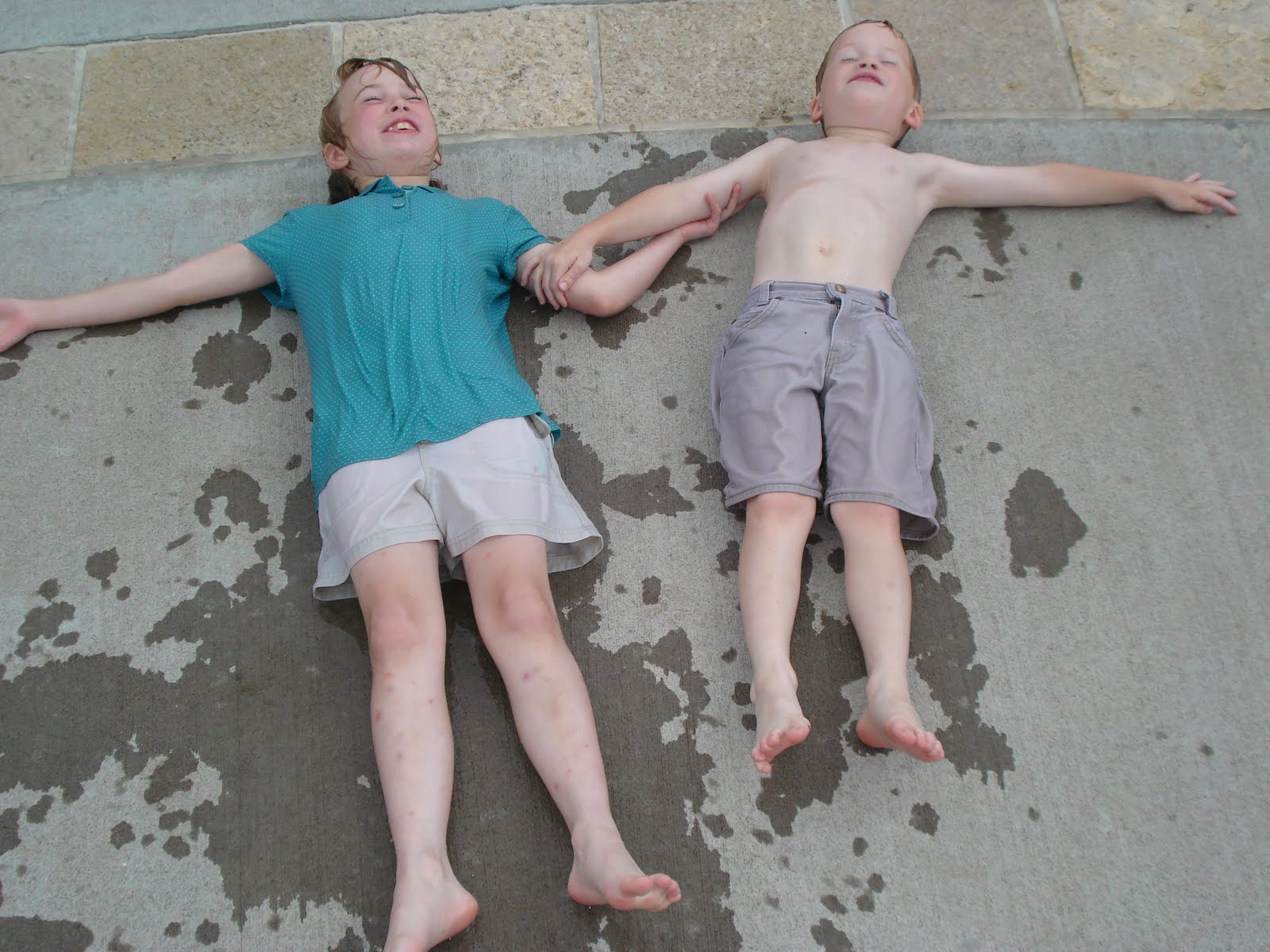
Some bring swim suits for their kids to test the fountain waters. I watched, incredulous, as these tentative, suburban children walking the edge of the fountain. Not these two - reckless abandon would better describe them. That makes me smile. We save the fountain for last, looking forward to the cold refreshment after getting all hot and sticky on the garden trails. Somehow it seems a little more fun, perhaps illicit, to play in the fountain wearing your clothes. Mommy even gets in the water - sorry, no pictures of that. When they are tired, soaked, and happy, the kids laid on the cement path to warm and dry themselves (just a bit) before we made our way home.

Friday, November 13, 2009

Bristol Ridge Vineyards

Early last summer, Mr. L. & I got together with friends at a favorite vineyard and winery - Bristol Ridge Vineyards. It is still run by the same family who established it in 1979 as the first winery in Johnson County, Missouri. The winery itself sits atop a high hill and you cans see for miles. The grounds are lovely and the hospitality warm.

Bristol Ridge Vineyards & Winery

Tasting room courtyard.

We found a shady spot to relax.

Time for cheese, crackers, & conversation.

View north from the hilltop vineyard.

Sweet little gazebo.

Mr. L. & me. (A Guiness shirt at a winery?)

Thanks for fun day Bristol Ridge!